Pokémon Type Chart: Why Attack and Defense Are Not Reversible
Pokémon Type Chart: Why Attack and Defense Are Not Reversible
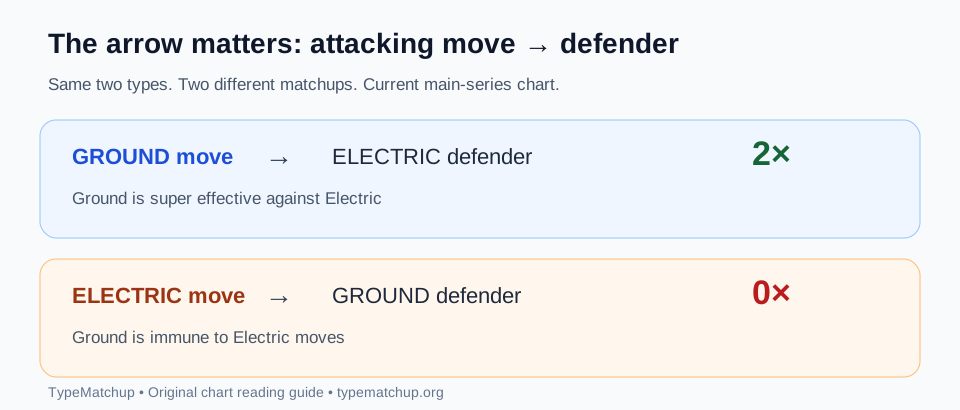
No—you cannot read the Pokémon type chart backward. The type of the move goes on the attacking axis, and the type of the target Pokémon goes on the defending axis. Ground-type moves hit pure Electric-type targets for 2×, but Electric-type moves hit pure Ground-type targets for 0×. Reversing the two types changes the question.
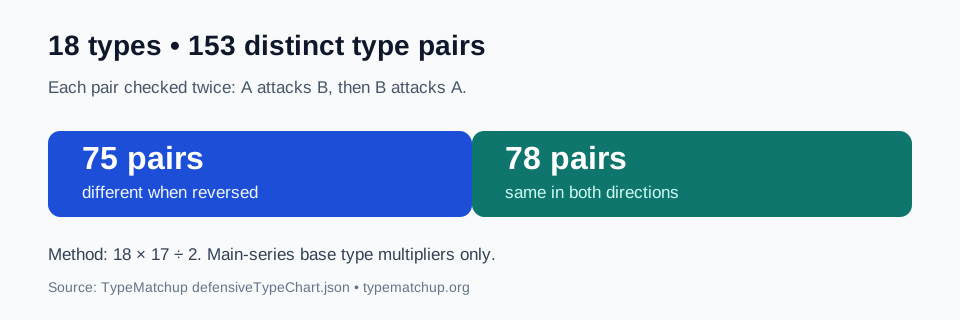
This is not a rare technicality. We compared every pair of different types in the current 18-type main-series chart using TypeMatchup's underlying data. Of the 153 unordered type pairs, 75 have different multipliers when attacker and defender are switched; 78 have matching multipliers. These counts describe base single-type effectiveness only—not a Pokémon's actual total battle damage. The full calculation and the ten case studies are below.
A direction-check table: ten matchups that fool people
The left and right results answer different questions. Each column says the attacking move type first.
| First attack → defender | Multiplier | Reverse attack → defender | Multiplier | What changed? |
|---|---|---|---|---|
| Ground → Electric | 2× | Electric → Ground | 0× | An immunity applies only to one direction |
| Fire → Steel | 2× | Steel → Fire | ½× | A weakness becomes a resistance |
| Dark → Psychic | 2× | Psychic → Dark | 0× | Dark is immune to Psychic moves |
| Ice → Dragon | 2× | Dragon → Ice | 1× | Dragon is weak to Ice, Ice is not weak to Dragon |
| Fairy → Dragon | 2× | Dragon → Fairy | 0× | Fairy blocks Dragon moves |
| Steel → Poison | 1× | Poison → Steel | 0× | Steel is immune to Poison moves |
| Water → Rock | 2× | Rock → Water | 1× | Water resists Rock? No: Rock is neutral against Water |
| Flying → Ground | 1× | Ground → Flying | 0× | Flying's Ground immunity is defensive |
| Ghost → Fighting | 1× | Fighting → Ghost | 0× | Ghost blocks Fighting moves |
| Fire → Grass | 2× | Grass → Fire | ½× | Fire attacks Grass well and resists Grass |
All results come from the site's modern type matrix, not search-volume estimates. An arrow means attacking move → defending Pokémon. Pokémon abilities and battle-specific effects can alter the outcome.
The correct way to read the chart
Ask these three questions in order:
- What is the move's type? That is the attacker.
- What type or types does the Pokémon receiving the hit have? Those are defenders.
- What does the chart say for each defending type? Multiply the factors only if the Pokémon has two defensive types.
For the full modern matrix, open the Pokémon type chart. For live calculations, select two defensive types in the dual-type calculator.
Original data check: 75 asymmetric pairs out of 153
With 18 types, there are 18 × 17 ÷ 2 = 153 ways to choose two different types without counting the reverse as another pair. We then computed two values for each unordered pair:
- the effectiveness of an attack of type A against a pure type B defender;
- the effectiveness of an attack of type B against a pure type A defender.
If the two numbers differed, we counted that pair as asymmetric. Otherwise it was symmetric.
| Category | Distinct pure-type pairs | Definition |
|---|---|---|
| Asymmetric | 75 | A → B differs from B → A |
| Symmetric | 78 | Both directions have the same multiplier |
| Total | 153 | All unordered pairs of 18 different types |
This figure is reproducible against the website's maintained data/defensiveTypeChart.json using the same underlying rules as the calculator. It is a property of the modern main-series chart, not an official survey statistic or a claim that 75% of all battles play differently.
Some pairs really are symmetric
Not every reversal changes the answer. For example, a pure Normal-type move versus a pure Ghost-type defender is 0×, and a pure Ghost-type move versus a pure Normal-type defender is also 0×. Both directions are immune. By contrast, Ground/Electric is maximally directional: Ground hits Electric super effectively, Electric has no effect on Ground.
This is why remembering a type pair is not enough. Remember the attack direction—or check the chart.
When the target has two types
Direction comes before multiplication. Suppose you use an Electric move on a Water/Flying Pokémon such as Gyarados:
Electric → Water = 2× and Electric → Flying = 2×, therefore 2 × 2 = 4×.
Now reverse the roles. A Water move into a pure Electric Pokémon is 1× and a Flying move into Electric is ½×. Those are separate attacks with separate move types; they are not a reverse “Water/Flying attack.” Reversing defenders and attack types would confuse both the direction and the dual-type multiplication step.
For more examples, see how to read a dual-type chart, which covers 4× weaknesses, ¼× resistances and immunity cancellation.
A quick decision routine during a battle
If an opponent switches a Pokémon into your move, look up the move's type against that Pokémon. Do not reason from “that Pokémon's type is strong against mine”; offensive strength and defensive resistance are separate relations. When changing moves, repeat the lookup for the new move. When switching Pokémon, repeat it for the new defender.
The table reports only the base type multiplier. The actual damage also depends on factors including move power, stats, STAB, weather, abilities, held items and battle mechanics. In Scarlet/Violet, a normal Tera type can replace the Pokémon's original defensive typing; then you must look up the new defender. See our Tera type guide.
A tiny paper exercise
Try answering each before checking:
- Electric move into Ground? 0×.
- Ground move into Electric? 2×.
- Poison move into Steel? 0×.
- Steel move into Poison? 1×.
- Dragon move into Fairy? 0×.
- Fairy move into Dragon? 2×.
Each is a direction check rather than a memory test about which type sounds “stronger.” If you can state move → defender, you can always recover the answer from the matrix.
Reference charts
We independently cross-checked the type-chart convention with Pokémon Database's type matrix and the official Pokémon Singapore type chart. The pair counts above were calculated from TypeMatchup's local type data, not copied from either site. For Pokémon GO, use the separate GO chart guide: its damage multipliers and treatment of immunities differ from the main-series rules.